A lot of talk floats around of creating IT as a strategic component when 60% of its activities are service or support related. The art of IT alignment with proper governance wrapped around them not only makes IT a strategic component but enables its support functions to add value to business assets and services. In some instances values can be quantified in financial terms and in some non-financial terms. The non-financial terms are equally important as they fuel the financial components on a continuous form of inputs or future ROI's and VOI's. These non-financial value creation ideas can be:
1) Customer Perceptions: Customer's preferences are influenced by perceptions and in turn perceptions are influenced by attributes of a service or product in terms of value, desire, previous experience, position in the marketplace, need and self-image.
2) Reference values of services: This may be very vaguely defined and sometimes may be plain facts. To find our reference value of services or products, an organization needs to create a on-going dialog with its customers that feeds data into a knowledge base that teaches the producer or creator of the service or the product valuable lessons learnt, what brings value, how value can be added and how best take advantage of preferences and perceptions the customer generates.
3) Finally the economic value of a service to a customer is the sum of the customer's reference value and the net difference in value the customer associates with the service. The positive difference comes from the service's utility and warranty. Negative difference comes from losses suffered by the customer as a result of utilizing the service.
Thoughts,
Sam
Saturday, December 25, 2010
The Expanding Universe
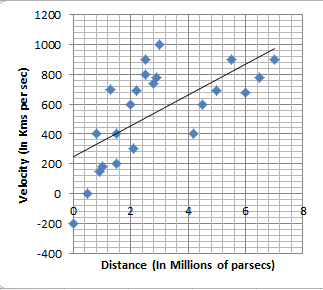
Thinking about regression, I came across Edwin Hubble's data in the Astronomy magazine and found out that the scatter-plot of the data Hubble gave played a central role in the discovery that universe is expanding. The graph below shows the distances from earth of 24 spiral galaxies, just for kicks I plotted this in excel, the speed indicates the speed at which these galaxies are moving away from us as reported in 1929 by Hubble's data.
The scatter-plot clearly indicates a linear relationship my TI-83 reports a r=0.7842 correlation which means that distant galaxies are moving away rapidly. Astronomers believe that there is a perfect linear relationship along with the scatter caused by imperfect measurements. The two lines on the plot are actually the two-least squares regression lines. The regression line of velocity on distance is solid as indicated. The regression line if drawn of distance on velocity will be different and both lines will have different slopes.
Lesson learnt : There is a close connection between correlation and the slope of the least square regression line.
Thoughts.
Sam
Statistical Thinking - Regression?
Regress means to go backward. How did the term regression come to be? Sir Francis Glaton (1822-1911) was the first one to apply regression techniques on biological and psychological data. He observed data in heights of tall parents and found that often taller than average parents tended to have children who were also taller than average but not as tall as their parents. Galton called this fact "regression" toward the mean and the name came to be applied to statistical method.
A regression line is very important measure in research then because a regression line summarizes the relationship between independent and dependent variables. as in specific settings one of the variables helps explaining or predicting the other.
Why am I relating this here? I remember a year I talked about visual mapping with mind map, certainly our brain does not always think in linear fashion, thoughts, ideas projects, to do's, likes, dislikes, desires, passions, etc are all over the place. So the question is while amassing information on architecture can you take your visual mindmap and plot out a linear regression?
Thoughts?
Sam
Sunday, November 28, 2010
Wisdom - Statistical Thinking!
Of all the branches of Mathematics, Statistics has a very practical application in solving real world problems. Though I firmly believe all wisdom and knowledge come from God, the area of Statistics falls under the wisdom spectrum as it gives innate ability to understand and give answers to practical problems. I am sure when Joseph and Daniel conducted the affairs of Kings they had a sort of statistical wisdom. Take for example Abraham Wald (1902- 1950) worked on war problems during World War II. Wald invented some statistical methods that were military secrets until the war ended. He was asked a probing question as to where extra armor should be added to airplanes. Wald studied the data of the location of enemy bullet holes in planes returning from combat. He then plotted the locations on an outline of the plane. As data accumulated, most of the outline filled up. He then came back with the solution and told them to put the armor in the few spots with no bullet holes. Wald said that is where bullets hit the planes that didn't make it back.
Sunday, November 21, 2010
Analysis of SAP’s Platform Strategy
The software industry has been through high and lows up with the constant advent of new technological innovations and rapid changes in the global economic landscapes. SAP is the leading enterprise application software giant started by Hasso Plattner. The rise of Enterprise application industries started in early eighty’s with organizations needing one single software program that was capable of serving the multiple needs and functions of various departments. One single enterprise-wide application software means integrating applications that fused together for the smooth exchange and extraction of information. For example when customer services sold a product and got stock updated in the inventory by the warehouse people and the same data could be pulled by the Finance department. Enterprise Application software’s were designed exactly to do the latter mentioned processes seamlessly. SAP started by break away engineer’s Plattner and group build the company on strong engineering forte to build these types of applications that served large enterprise needs.
Samuel Tsang and Farhoomand have attempted to explain SAP’s platform strategy in the changing scenarios of the enterprise application software market to survive and sustain itself in the market competition. They give a brief overview of the impact of ERP (Enterprise Resource Planning) on the enterprises, the downturn in the ERP Market, and the new trends in software industry, the advent of service oriented architecture and pay as you go model of software services. The authors of the paper go to explain competitive strategies of SAP’s competitors like ORACLE, Microsoft, IBM and the new breed of companies from the east that pose as a viable threat to its market share.
SAP has traditionally enjoyed the high market share. The early eighty’s and early ninety’s enterprise software’s were considered complex proprietary and hard to implement software’s. SAP with its closed source software made high margins and capitalized its position in the market. However with the rapid changing trend of the technology especially with the advent of Internet and open source models SAP soon found itself in a sticky situation. This often happens to giants who have not effectively managed their structures and aligned their strategies with changing market scenarios. SAP soon found it would have to open its proprietary software products for open development and integration, lure in small and mid-size businesses and modify its ERP applications to be web based.
Bourgeois quotes “The development of organizational strategies is to guide organizational activities. They are key managerial functions and that guidance is accomplished through the effective co-alignment of organizational resources with environmental conditions” (Bourgeois, 1980, p 37). Thus strategy making lies in the skill and abilities of the managers who respond strategically in things that must be done to adjust to the environmental forces that impact their organization (Thompson, Strickland & Gamble, 2007). This involves dealing with all factors like political, economic, cultural, regulatory & governmental and technological innovations that happen from time to time. SAP’s position as a market leader was being challenged in all the above macro environmental factors with its interaction in the market place. The author will attempt to analyze from the paper SAP’s position using PEST.
The political landscape in the enterprise market was changing rapidly with SAP’s key arch rival Oracle. Oracle mainly served the database market and supplied functional software’s that supported the back office operations. SAP and Oracle both dominated the enterprise application software market but in different parts of it (Farhoomand, 2006, p.11). Oracle’s hostile bid on PeopleSoft in 2003 to acquire PeopleSoft clients which was a player against SAP was turned down but in 2004 the takeover was complete at $10.3 billion which affected SAP’s market considerably. SAP to correct its position attempted to take over Retek a retail software developer for about $500 million to align its portfolio but again Oracle strategically acquired 10% of Retek and later on purchased Retek for $670 million which in turn led to the development of Oracle’s business unit called Oracle Retail Global (Farhoomand, 2006, p.12). SAP’s market share was now being affected in the enterprise application market with Oracle’s key acquisitions.
Oracle’s also equipped itself in serving enterprise software’s as services for its clients, this was also a strategic attack on SAP’ high costing implementation thus economic spheres of SAP’s core business model was threatened. At the same time the economic landscape was changing rapidly with the rise of small and mid-size businesses, the largest software maker Microsoft quickly capitalized on this segment by implementing strategies and not directly engaging Oracle or SAP. Here again SAP was late in its strategy alignment of scaling down the ERP software’s to fit the business needs of small and mid-scale enterprises. In the 1990’s SAP also was caught up in failed implementation of its key products with large enterprises like Dell, Nestle and other companies who could not change or scale their business model to the requirements of SAP software’s.
In the cultural sphere SAP didn’t quickly realize the power of open source and independent developers that were providing enterprise wide solutions. Businesses were piece by piece stitching their needs by buying software’s from these types of vendors. Companies were increasingly adopting strategies by buying modules from niche software makers. Farhoomand states according to a survey conducted by Harvard Business School 60% indicated their companies had adopted the approach piece-meal software’s together to serve enterprise needs (Farhoomand, 2006, p.4). This approach benefited businesses as CEO’s increasingly were demanding from their Chief Information Officer’s return on investments on the corporate IT spending.
Technology factors impacted SAP heavily with the advent of the Internet. Organization’s found suddenly the need of becoming e-business ready with e-commerce and access information on the power of networked economy. SAP introduced mySAP.com a software package aimed to become a business to business portal. To catch up SAP engaged in acquisition strategies of e-procurement software companies. Another major change in the technology sphere was the rise of service-oriented architecture which was a framework of developing and integrating application through Web Services. This meant an application could be developed in .net, java or any legacy system and could be easily all integrated by Web Services. Traditionally Businesses bought technology solutions and had many systems running, the SOA model suddenly allowed talking between different systems to be easy and a matter of configuring the components. This was to greatly impact the Enterprise Application software giants as they would not only would lose a large market share but had to rethink their strategy implementations in coming up with a product that used this powerful model. SAP’s response to this came in a product called NetWeaver which was essentially a Web Service solution which gave enterprises’ the option of connecting their legacy databases and systems.
SAP’s main strategy involved in expanding and covering functionally related markets. SAP’s strategy involved in branching out to related areas like customer relationship management (CRM), product lifecycle management (PLM), supply chain management (SCM) (Farhoomand, 2006, p.9). The focus now changed from not just aiming at the large enterprises but small and mid-size business ($600 million or less). This fast growing segment meant coming up with these functional products and cutting down development time by acquisition of companies that already had a decent product that served these functional needs supporting examples would be SAP acquiring Light hammer Software Development Corp. in mid 2005 and TopTier Software a Silicon Valley startup in 2001.
To serve the customer’s in the mid-market segment SAP scaled down its ERP products and came up with mySAP All in-One and SAP Business One. Also introduced was the pay-as-you-go model which combined elements of hosted and on-demand services.
SAP’s major strategy change came with the appointment of Shai Agassi as the chief of corporate product development who came on board with the acquisition of TopTier Software. The strategy was to open up SAP the proprietary software so individual developers could write and make extensions to it. SAP’s introduction was with a new flagship product called NetWeaver as mentioned earlier in the paper it was a platform that allowed applications to be developed and accessed as Web Services running on different systems. NetWeaver was given away free to solidify and expand the use of the software with third party developers. The strategy was successful by 2003 as it brought customer support and strengthened its core for its full fledged launch in 2007.
The introduction of NetWeaver was a very important one strategically both platform wise and in the economic sense of SAP’s survival in the marketplace as it helped configuring itself not to just depend upon its core engineering strength but successfully attract tens of thousands from the developer community supporting its model. To make this more successful SAP hired George Paoline who helped Sun Microsystems market Java to come on board and he soon was successful in forming a network on 132,000 individual developers as part of SAP’s online network (Farhoomand, 2006, p.11). SAP was also influential in hiring away 200 top managers from competitors like Oracle, BEA Systems, and Siebel to join their company (Farhoomand, 2006, p.11).
SAP thus successfully integrated its core engineering strength by the introduction of NetWeaver and connecting individual developers from the external environment to develop extensions and tying in legacy software’s that existed within businesses. Businesses actively supported this open model as it brought their own IT spending down. The introduction of NetWeaver as a platform was important strategy as it was crucial for SAP to enter and penetrate the new small and medium scale enterprise customers as it was the biggest growing segment. During the economic downturn with dotcom’s crashing, SAP was able to leverage its strength of being an established software vendor which was reliable and customers turned to it for their needs. This gave also SAP sufficient time to catch up with the Internet Boom and bringing out key products like mySAP.com and building and scaling of enterprise portals that were web based to serve enterprise needs. Porter in his famous paper quoted “Competitive strategy is about being different. It means deliberately choosing a different set of activities to deliver a unique mix of value” (Porter, 1996, p.64). SAP has attempted to create this unique mix of value by the introduction of these products.
The Enterprise marketplace continues to be an interesting and a fierce battle arena as small players are challenging the might of the established giants. The feature rich application with simplicity at its core which increases organizational effectiveness and overall efficiency at the lowest cost will win and the organization that aligns its strategy to bring that into the market will be the final winner.
Thoughts,
Sam Kurien
Paper written for Platform Strategy for SAP
References:
Borgeouis, A.M., III. (1980). Strategy and environment: A conceptual integration. Academy of Management Review, 2(1), 25-39.
Thompson, A. Strickland, A., & Gamble, J. (2007). Crafting and executing strategy: The quest for competitive advantage (15th ed.). New York: McGraw-Hill.
Porter, Michael E (1996). What is Strategy? Harvard Business Review, 74, 6, 61-78.
Ali F. Farhoomand, Samuel Tsang (2006). SAP’s Platform Strategy in 2006, University of Hong Kong, 1-27
Monday, November 8, 2010
Extension of An Innovation!
I recently was made aware that immediacy of objects, values and street innovation extend the product ideas that will be instrumental in making them universal. The lessons to be learnt are how do you design a product or a system that can be extended or be universally accepted. The proposed idea is to watch for ideas that come from the streets, reverse engineering, social re-engineering and innovative social uses of products or ideas.
For example to expand on this a cell phone owner in Uganda becomes an instant ATM. Strange Isn't it? People in Uganda use cell phones to transfer money and exchange minutes for cash. How does it work you may ask? So if you live in Kampala and have a cell phone and you want to send money to your parents in a small village a few hundred miles away you would buy a pre-paid phone card with minutes on it and transfer it to a person in the village where your parents live who has a cell phone. So from Kampala you would call this person and give him the card number transferring the minutes on your card. The cell phone operator on the other end who receives your call charges a 2-10% commission, collects the minutes and dispenses the remaining cash to the caller's parents.
Street innovation and extension of a innovation or idea gives insights how the Ugandans use an everyday object like the cellphone in the absence of a sophisticated banking system.
Thoughts?
Sam Kurien
Resonance - 'A Film about Design Strategy'
Design Strategy for a firm or project is a complex process. Here is a video how innovation design consultancy firm "Continuum" approaches it in a film they produced called 'Resonance: A Film About Design Strategy.'
I like the concept of connecting insights to values and coming up with the right idea to produce a solution. BRILLIANT!
Enjoy!!
I like the concept of connecting insights to values and coming up with the right idea to produce a solution. BRILLIANT!
Enjoy!!
Subscribe to:
Posts (Atom)
-
Enterprise Architects/IT Teams along with their business counterparts struggle with the idea of how to effectively engage the senior leaders...
-
I feel IT Governance is the most an important function under the umbrella of the CIO. Since Technology Governance is a overarching organizat...
-
Often there is a need to run a Silverlight application full screen. This is often achieved by creating a small button or a link which toggle...