Showing posts with label Business Intelligence. Show all posts

Friday, November 9, 2012

Data Artisan's

I like the term "Data Artisans"

George Mathew, president and COO of Alteryx, predicts one of the hottest jobs in the future will be the "data artisan," a hybrid role that mixes data analysis with business savvy. "Data artisans will be asked to pull from structured and unstructured sources to drive the most important decisions within an organization -- like where it should open its next retail location, whether to pursue a new market, and which products to push,"


There's a lot of talk about big Data! and data artisans will be the new breed of thinkers that are strategically going to make management revolution by utilizing the technology around them. Though these are fancy new terms and not new for manager's who have always used data driven approach, yet the software tools that are available have grown leaps and bounds. These tools allow Data Artisans for handling large volume's of data, along with speed at which this data is being collected in real time to make substantial decisive actions.

A recent article on Big Data in HBR summarizes that data driven decision are better decisions as it enables the manager to look at evidence rather than intuition. It comes easy for companies that were born digital like Amazon and Google who are masters on big data. To know buying behavior and having key insights on what a consumer thinks that affects the bottom line changes the very fate/profits and direction of your organization.

Some key points I want to record here:

1) Big Data does not replace insight
2) Big Data does not replace vision
3) Big Data cannot replace value but can definitely help in understanding, inferring how our people are doing on core value.
4) Big Data coupled with insight will give you an edge in speed of decision making.
5) Big Data coupled with insight will help you minimize cost by allowing you to refocus your strategies.
6) Big Data has several kinds of information descriptive that may be (financial, demographic, pschyographic and social data), it could be Behavioral (response rates, likes, dislikes, activity, purchase rates etc etc. and finally Attitudinal (loyalty, satisfaction,  behavioral affinities etc.)
7) Tools that can close the loop on feedback and refine complex information in each of the mentioned areas in point #6 in simplistic manner (specially visually) help communicate and further your Organization better.

Thoughts,

Sam Kurien

Saturday, January 1, 2011

Availability Manager Functions & AM Metrics

Availability Managers ensure that the service provided from the service catalog are met and delivered to the customer's utmost satisfaction. The primary responsibilities of the availability manager include:

  1. Ensuring that all service deliveries fulfill and match the established SLA's
  2. Ensure and categorize that all levels of availability of services, escalation and solutions are provided in time
  3. Validating that final designs meet minimum required levels of availability
  4. Assist in the exploration of all incidents and problems that cause availability issues.
  5. Participate in the IT infrastructure design that entail hardware and software in relation to availability fulfillments.
  6. Finally establish and use Availability metrics to measure availability, reliability and maintainability of services.
I think the last point entails a major percentage of the Availability manager's job and its important then to list the most commonly used metrics that a AM uses. To measure availability of a services one can subtract the amount of downtime from the Agreed service Time (AST), divide the result by the AST, and then multiply this number by 100 to obtain a percentage.


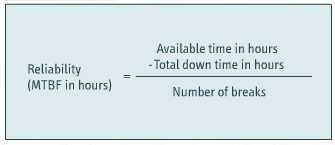
The reliability of a service can be measured in either MTBSI or MTBF which is mean time between service incidents and mean time between failures. To calculate the reliability of a service in MTBSI you divide the available time in hours by the number of breaks in service availability.

The maintainability of a service is measured in MTRS which is the mean time to restore a service. You calculate the MTRS by dividing the total downtime in hours by the number of service breaks.


On the note of delivering  the best service.

Sam Kurien

Saturday, December 25, 2010

Statistical Thinking - Regression?

Regress means to go backward. How did the term regression come to be? Sir Francis Glaton (1822-1911)  was the first one to apply regression techniques on biological and psychological data. He observed data in heights of tall parents and found that often taller than average parents tended to have children who were also taller than average but not as tall as their parents. Galton called this fact "regression" toward the mean and the name came to be applied to statistical method.

A regression line is very important measure in research then because a regression line summarizes the relationship between independent and dependent variables. as in specific settings one of the variables helps explaining or predicting the other.

Why am I relating this here? I remember a year I talked about visual mapping with mind map, certainly our brain does not always think in linear fashion, thoughts, ideas projects, to do's, likes, dislikes, desires, passions, etc are all over the place. So the question is while amassing information on architecture can you take your visual mindmap and plot out a linear regression?

Thoughts?

Sam

What is a Vector Database?