Saturday, January 1, 2011

Availability Manager Functions & AM Metrics

Availability Managers ensure that the service provided from the service catalog are met and delivered to the customer's utmost satisfaction. The primary responsibilities of the availability manager include:

  1. Ensuring that all service deliveries fulfill and match the established SLA's
  2. Ensure and categorize that all levels of availability of services, escalation and solutions are provided in time
  3. Validating that final designs meet minimum required levels of availability
  4. Assist in the exploration of all incidents and problems that cause availability issues.
  5. Participate in the IT infrastructure design that entail hardware and software in relation to availability fulfillments.
  6. Finally establish and use Availability metrics to measure availability, reliability and maintainability of services.
I think the last point entails a major percentage of the Availability manager's job and its important then to list the most commonly used metrics that a AM uses. To measure availability of a services one can subtract the amount of downtime from the Agreed service Time (AST), divide the result by the AST, and then multiply this number by 100 to obtain a percentage.


The reliability of a service can be measured in either MTBSI or MTBF which is mean time between service incidents and mean time between failures. To calculate the reliability of a service in MTBSI you divide the available time in hours by the number of breaks in service availability.
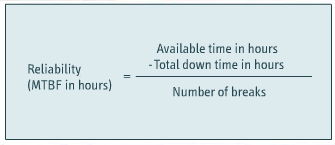
The maintainability of a service is measured in MTRS which is the mean time to restore a service. You calculate the MTRS by dividing the total downtime in hours by the number of service breaks.


On the note of delivering  the best service.

Sam Kurien

Availability Management

On continuing to discuss infrastructure management processes - the objectives of Availability management process can be summarized as the following:

  • To produce and maintain an appropriate and up-to-date Availability Plan that accurately reflects current and future needs of the organization.
  • To offer advice and guidance to all other areas of the organization and IT on availability-related issues.
  • To ensure that availability achievements meet or exceed targets.
  • To assist with the diagnosis and resolution of availability-related incidents and problems.
  • To evaluate the influence of any changes on the Availability Plan and on the performance and capacity of all services and resources. 
  • To ensure that all cost-effective measures to improve the availability of services are implemented. 
I like the fact that Availability Managements processes incorporate reactive and proactive activities.  We can't get away from reactive activities as service level activities are dynamic in nature hence involve monitoring, measuring, fulfilling, analyzing and fixing problem on unavailability. Proactive activities refer to more into planning, designing, re-designing  and process improvement steps. So we see reactive activities are operational in nature whereas proactive activities of Availability management process fall under more planning functions.

Thoughts on Availability Management.

Sam Kurien

SLM In a nutshell

On reviewing the 14 activities of SLM in my previous post, I couldn't help summarize in a nutshell what SLM is all about. Its a note that I need to remember for the future so here it is:

Service Level management process compromise main phases that cover different activities and they are
  • Negotiating
  • Monitoring
  • Reporting &
  • Reviewing
The negotiating phase involves activities likes designing SLA frameworks, documenting, OLA's, and obtaining agreements of requirements while developing contacts and relationships. The monitoring phase involves monitoring the performance of SLA's, collating measuring and improving customer satisfaction. The reporting phase involves producing service reports and logging + managing complaints & compliments. Finally the reviewing phase of SLM is all about revising underpinning agreements, revisiting OLA's, conducting service reviews, and instigating continuous improvements. 

Thoughts,

Sam Kurien

14 Activities of a SLM

OK I didn't want to post something on service level management on the very first day of the new year but here it is. I find it fascinating that Marketing Management and Service level Management implementations within the IT framework are so similar.The end result of any SLM process is satisfying the customer's requirement for that specific time not over-delivering.  So here is the run down on the the 14 activities of a good SLM.

1. Confirming stakeholders, managers in key business areas and customers
2. Maintaining accurate information within the Service Catalog and Service Portfolio
3. Being flexible and responsive to the needs of the customer
4. Developing a full understanding of the customer, customer's organization and strategies
5. Regularly sampling the customer experience (This is an interest area for me because metrics will reveal treatments in the service level adjustments, development of new products/services and new strategies)
6. Conducting customer surveys and acting on the results
7. Ensuring that the correct relationship processes are in place to achieve objectives.
8. Marketing and exploiting the Service Portfolio and Service Catalog
9. Assisting with the maintenance of a list of outstanding improvements.
10. Ensuring that the organization and customers understand their responsibilities
11. Facilitating the negotiation of SLR's and SLA's
12. Raising the awareness of the business benefits when using new technology.
13. Promoting service awareness. (this is important because that will produce the appropriate perception)
14. Ensuring that IT provides the most appropriate levels of service.

Thoughts on new year's day.

Sam Kurien

Thursday, December 30, 2010

Probability - And Business Decisions!

Studying statistics is an interesting endeavor as business activities are so closely related to observation, formulation of strategies and extrapolation for analysis of data and implementation of new strategies. The behavior of large groups of people can be as random as coin tosses as mentioned in the previous post. In fact the entire life insurance business is based on this fact. We can't predict whether a specific person will die next year (except for my mother who can predict deaths through dreams...no pun intended she seriously can.) But if we observe millions of people, deaths are random. Hence make accurate prediction models for payouts. The proportion of men aged 25 to 34 who will dice next year is about 0.0021 say on the North American continent. When you have this data compared to the probability of death in women which about 0.0007 for the same range an insurance company tat sells many policies to people aged 25 to 345  will have to pay off on about 0.21% of the polices sold to men and about 0.07% of the policies sold to women.

So we see the law of large numbers applies as the mean of a fairly accurate sample moves towards the mean of the population (in this case the overall customers) very slowly. The law of large numbers is the foundation of such business enterprises like gambling casinos and insurance companies.The winnings (or losses) of a gambler on a few plays are uncertain - that's why gambling is exciting. If you take 100 gamblers and make 100 observations the mean of the sample is not very close to mean of the population, it is only in the very long run that the mean outcome is predictable. The house plays tens of thousands of times so the the house unlike individual gamblers can count on the long run-regularity described by the law of large numbers. Hence the average winnings the house on tens of thousands of plays will be very close to the mean of the distribution of winnings which translates effectively to say that the mean guarantees the house a profit and that's why gambling like insurance is usually a profitable business. At the end of the day the odds are always stacked up against the consumer. 

Thoughts, 

Sam Kurien

Randomness & Probability

The idea of probability is empirical. I chuckled when I twittered last night on Einstein's quote that- "God does not care about our mathematical difficulties. He integrates empirically". So probability is the art of observing a class of data closely and describing the data in several trials. Hence Randomness or "Random" behavior in statistics is not a synonym for "haphazard" but a description of a kind of order that emerges only in the long run.

The French naturalist Count Buffon (1707 - 1788) tossed a coin 4040 times. The results were 2048 times heads which means 0.5069 chances for the heads to occur. Around 1900 Karl Pearson heroically tossed the coin 24,000 times result was 12,012 heads, a proportion of 0.5005. John Kerrich while imprisoned in the German Nazi camp tossed the coin 10,000 times the result of which was 5076 heads, a proportion of 0.5067. So to make a point about randomness and probability we call a phenomenon random if individual outcomes are uncertain but there is a regular distribution of outcomes in a large number of repetitions, what I am interested in is under the density curve how this randomness can be plotted to make accurate assumptions. The probability of any outcome of a random phenomenon is the proportion of times the outcome would occur in a very long series of repetitions.

I think gamblers and lay people always express this idea in terms of "What are the odds rather than probability?" Odds of A to B against an outcome means that the probability of that outcome is B/(A+B). So "odds of 5 to 1" is another way of saying "probability is 1/6". A probability is always between zero and one as per the laws of probability but odds range from to zero to infinity.

I wonder if some of the Vegas regulars apply laws of probability?

Thoughts.

Sam Kurien

Tuesday, December 28, 2010

Cool Illusion

Is the cowboy going or coming? I thought this was a cool illusion based upon the interpretation you can formulate your own story.